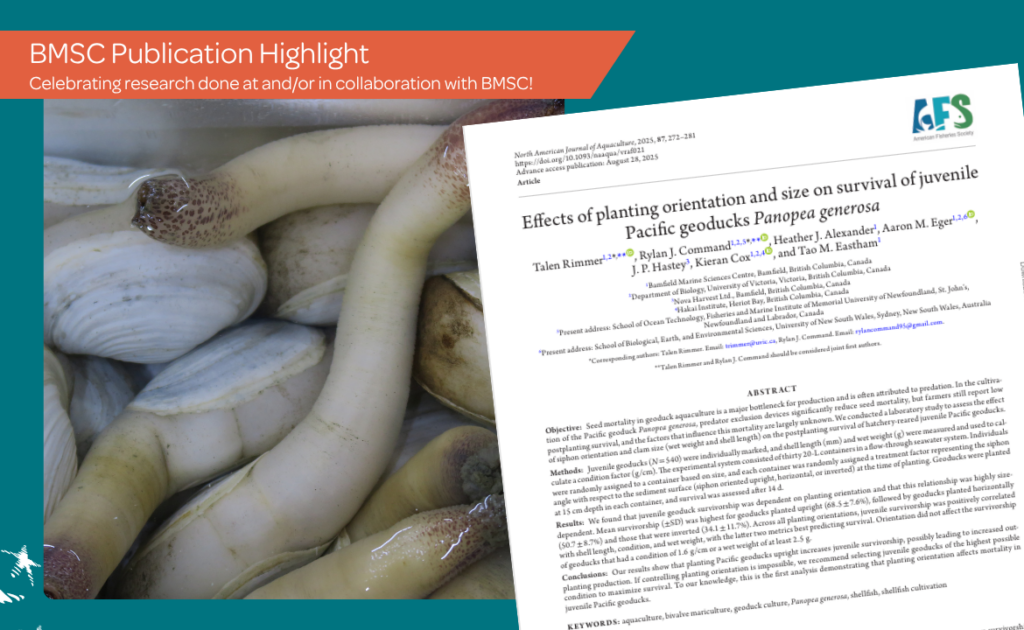
Today’s BMSC Publication Highlight is
Effects of planting orientation and size on survival of juvenile Pacific geoducks Panopea generosa
by Talen Rimmer , Rylan J. Command,, Heather J. Alexander, Aaron M. Eger,J. P. Hastey, Kieran Cox , and Tao M. Eastham.
In short
Planting orientation and size influence juvenile Pacific geoduck survival and should be considered by hatcheries to improve survivorship and to maximize yield.
So, with a bit more care during the planting process, we can improve the number of geoducks that survive and can be harvested later!
Why is this cool?
The authors Talen Rimmer and Rylan Command said:
“The geoduck industry was rapidly expanding at the time in British Columbia, with new ways to plant geoducks faster and more efficiently than ever before. However, the thing that folks at Nova Harvest told us was that there was a lot of unexpected mortality when they were planting these geoducks, and they weren’t sure why, but there was a hunch that [it may have been because] they were planting [the geoducks] with something called a hydraulic plough, which essentially shoots geoducks in random orientations into the sediment”
“…So in our study we tried to replicate that in a laboratory. Basically, we took 540 geoducks. We labelled them all. We put them in randomly sampled distributions into buckets at either (1) upright (2) syphon horizontal or (3) upside down. And we tracked whether or not after about a two week period, if they were still alive… we also tracked how big they were because we thought that maybe the larger geoducks, or the stronger geoducks, [may be able to right themselves] in order to breathe.”
“…And what we found out is, yes, if you plant geoducks upside down versus right side up there is over a 30% difference in effect size of survival after a two week period. And the same is true for size that the larger geoducks [could right themselves more easily].”
This is also neat because this work was done during the directed study course in the BMSC Fall Program in Marine Sciences in 2017!
Want to read the paper? Find it here.
Journal: North American Journal of Aquaculture, 2025, 87, 272–281
DOI: https://doi.org/10.1093/naaqua/vraf021
https://academic.oup.com/naja/article/87/4/272/8242757?login=false