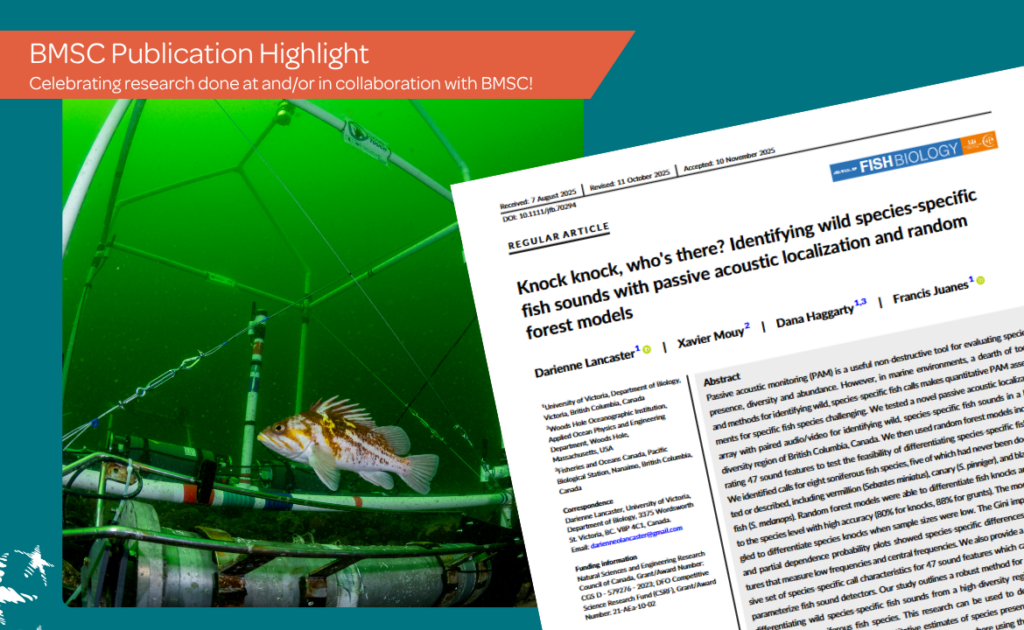
Today’s publication highlight is:
Lancaster, D., Mouy, X., Haggarty, D., Juanes, F., 2025. Knock knock, who’s there? Identifying wild species-specific fish sounds with passive acoustic localization and random forest models. Journal of Fish Biology 1–15. http://doi.org/10.1111/jfb.70294
In short
With this work, researchers were able to identify unique sounds for eight different fish species in the wild.
This is an exciting breakthrough as it allows researchers to know exactly which fish species live in an area just by listening to their calls. Just like we already do for birds! The field work for this project was carried out of BMSC!
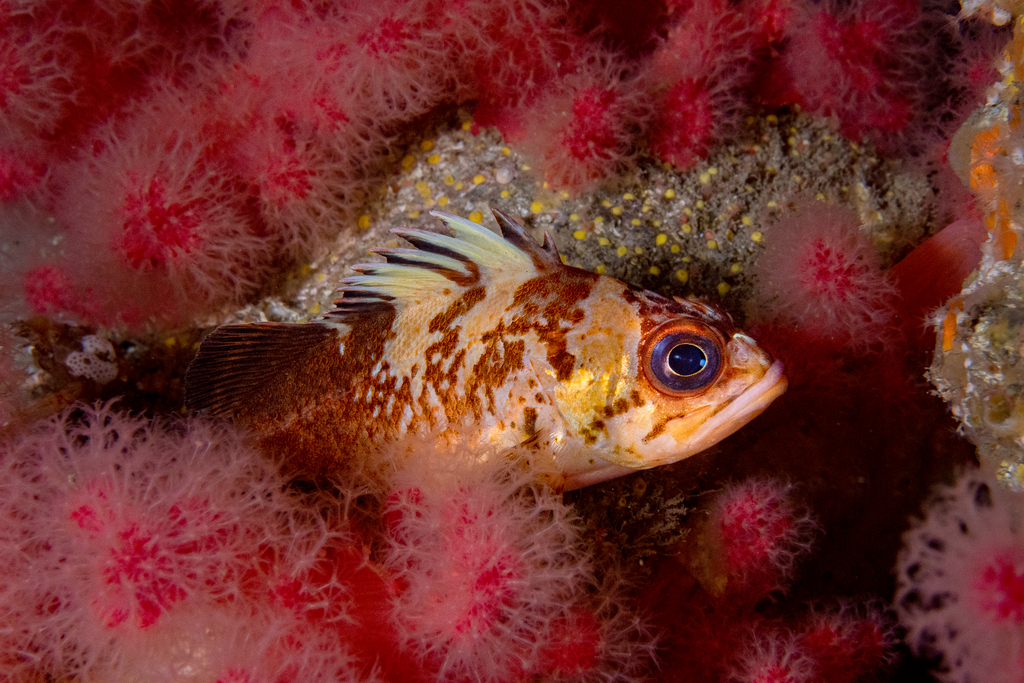
Image credits to Shane Gross
The How
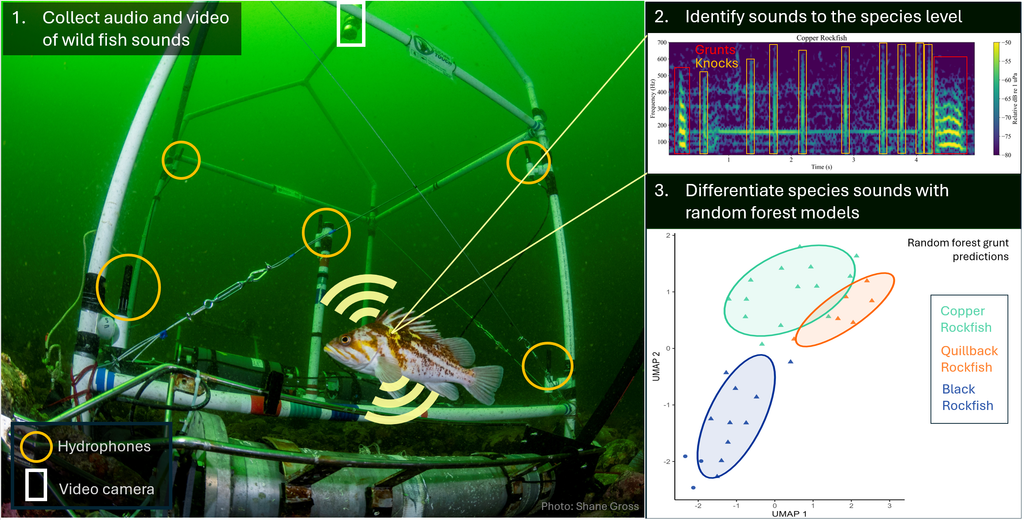
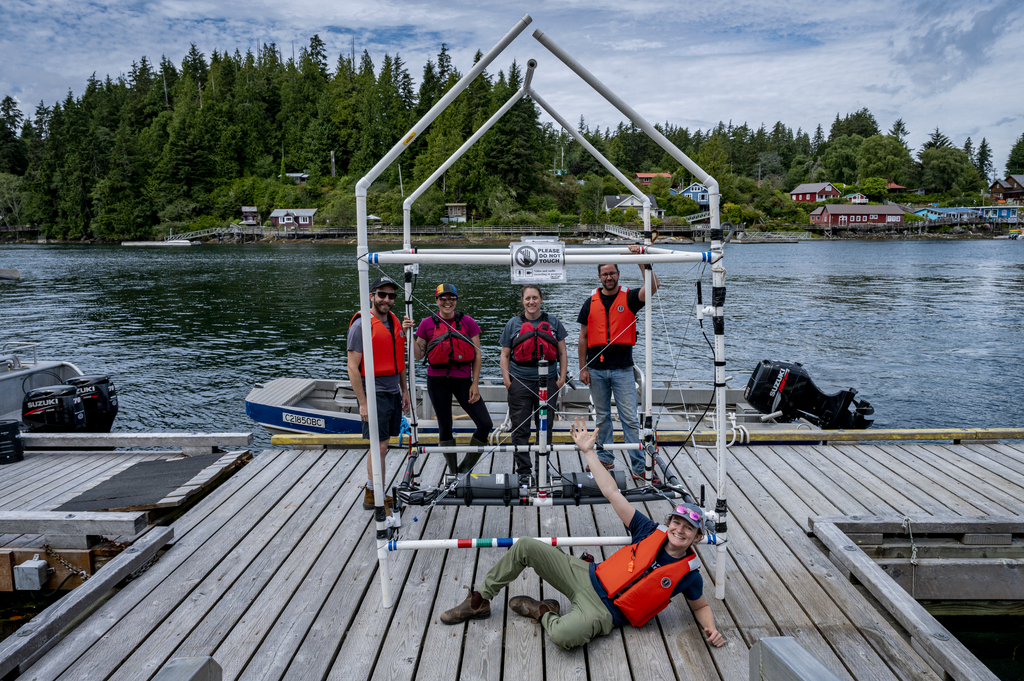
UVic PhD canidate Darienne Lancaster and team took underwater audio and video in the wild using a sound localization array designed by project collaborator Dr. Xavier Mouy. She then used sound characteristics like frequency (how high or low the sound is) and duration (how long the sound is) to identify differences in species calls.
Using a machine learning model the researchers were able to predict which sounds belonged to which species with up to 88% accuracy.
Why is This Cool?
UVic PhD canidate Darienne Lancaster and team took underwater audio and video in the wild using a sound localization array designed by project collaborator Dr. Xavier Mouy. She then used sound characteristics like frequency (how high or low the sound is) and duration (how long the sound is) to identify differences in species calls.
Using a machine learning model the researchers were able to predict which sounds belonged to which species with up to 88% accuracy.
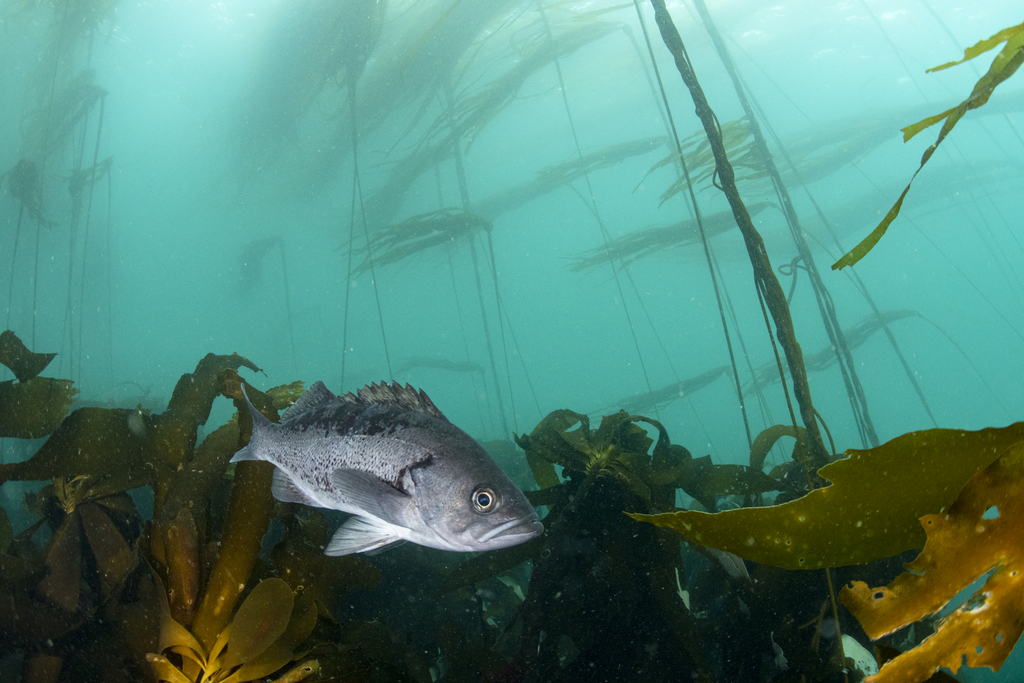
See this recording here of a black rockfish being chased by a lingcod – make sure your sound is on!
“Developing new, non-destructive ways of monitoring where fish species live is essential for effective marine conservation.” – Darienne Lancaster
These results have promising implications for conservation and fisheries management.
“Now that we know we can tell fish species sounds apart the possibilities are endless.We can create a fish sound detector that will tell us exactly which fish species were recorded at each location without disturbing the fish. We can also start looking at how to count fish using their calls so we can estimate abundance. This has massive implications for future conservation efforts and the techniques we used can be adapted by scientists all over the world to decipher other fish calls.”
Using recordings is less invasive and destructive, can collect more continuous data, and is less resource intense than traditional surveys.
Read the paper: https://onlinelibrary.wiley.com/doi/10.1111/jfb.70294
In The Media
This work was alos featured on Quirks and Quarks on May 23rd 2026!
https://www.cbc.ca/listen/live-radio/1-51-quirks-and-quarks/clip/16216344-eavesdropping-fish-find-whos